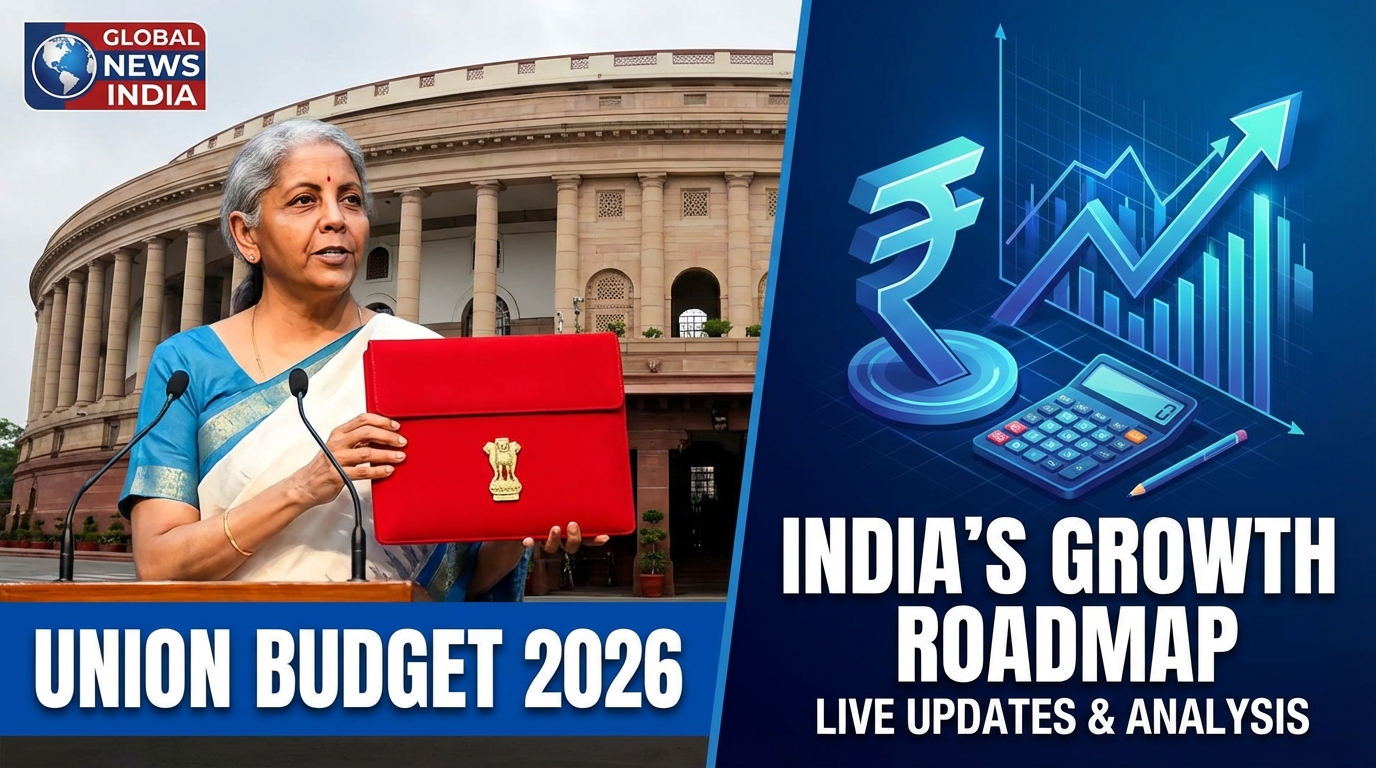
india union budget 2026
**India Union Budget 2026-27: A Blueprint for 'Viksit Bharat' and Sustained Economic Growth** On February 1, 2026, Finance Minister Nirmala Sitharaman presented the Union Budget for the Financial Year 2026-27. Designed against a backdrop of global economic uncertainties and shifting supply chains, the budget highlights a strategic pivot from post-pandemic recovery to long-term ecosystem building. Billed as a "Yuva Shakti" (youth power) driven financial blueprint, the 2026-27 Budget is anchored in three foundational *Kartavyas* (duties): accelerating sustainable economic growth, fulfilling citizen aspirations through capacity building, and ensuring inclusive development under the *Sabka Sath, Sabka Vikas* vision. Here is a detailed, well-researched breakdown of the key highlights and facts from the India Union Budget 2026. ### 1. Fiscal Math & Economic Indicators The government has maintained its commitment to fiscal prudence while significantly boosting capital expenditure to sustain growth momentum. * **Total Expenditure & Receipts:** The government estimates a total expenditure of ₹53.47 lakh crore, marking a 7.7% increase from the revised estimates of 2025-26. Non-debt receipts are projected at ₹36.51 lakh crore, with net tax receipts estimated at ₹28.7 lakh crore. * **Capital Expenditure (Capex):** Public capex has been raised to a record ₹12.2 lakh crore, serving as the primary lever for nationwide infrastructure development and job creation. * **Fiscal Deficit:** The fiscal deficit is targeted at 4.3% of the GDP, slightly lower than the 4.4% revised estimate of the previous year, keeping India on a downward debt trajectory with a medium-term target of reaching 50%. * **Disinvestment Target:** The disinvestment target has been set ambitiously at ₹80,000 crore, marking the first increase after five consecutive years of downward revisions. ### 2. Personal Taxation & Direct Taxes For individual taxpayers, the 2026 Budget prioritized stability, procedural simplification, and compliance ease over sweeping rate cuts. * **Income Tax Slabs Unchanged:** There are no changes to the income tax slabs under either the old or new tax regimes. The new tax regime remains the default option. Salaried individuals in the new regime will continue to benefit from a ₹75,000 standard deduction, and income up to ₹12 lakh remains effectively tax-free due to the Section 87A rebate of up to ₹60,000. * **New Income Tax Act, 2025:** Scheduled to come into effect on April 1, 2026, this framework will introduce simplified rules, redesigned return forms, and a shift from severe penalties to fixed, graded fees for procedural non-compliance. * **Tax Collected at Source (TCS) Relief:** The TCS rate on overseas tour packages and remittances for education or medical purposes under the Liberalized Remittance Scheme (LRS) has been slashed to a uniform 2% (down from 5% or 20%) effective October 2026. * **FAST-DS 2026:** To address the practical hurdles faced by small taxpayers, the Foreign Assets of Small Taxpayers Disclosure Scheme (FAST-DS 2026) provides a one-time, 6-month window for students, young professionals, and relocated NRIs to declare undisclosed foreign assets or income, subject to a 30% tax without prosecution. ### 3. Corporate Taxation & Financial Markets The corporate sector and capital markets saw significant regulatory and tax adjustments aimed at deepening financial resilience. * **Capital Markets & STT:** To curb excessive speculation, the Securities Transaction Tax (STT) was increased. The rate on options rose from 0.125% to 0.15%, and on futures from 0.02% to 0.05%. * **Share Buyback Tax:** All share buybacks will now be taxed as capital gains in the hands of the shareholders. Additionally, a new buyback tax is levied on promoters (22% for corporate promoters, 30% for non-corporate promoters). * **Minimum Alternate Tax (MAT):** The MAT rate has been reduced from 15% to 14% and is set to become a final tax starting April 1, 2026. Brought-forward MAT credit set-offs are now limited to 25% of tax liability in the new regime. * **Cloud & Data Centers:** To boost digital infrastructure, the budget granted a tax holiday until 2047 for foreign companies providing global cloud services routed via Indian data centers. ### 4. Key Sectoral Announcements & Manufacturing Push A core theme of Budget 2026 is an aggressive push to reduce critical import dependencies and establish India as a global manufacturing hub across frontier sectors. * **Biopharma SHAKTI:** A ₹10,000 crore initiative rolling out over five years to build an ecosystem for the domestic production of biologics and biosimilars, aiming to position India as a global biopharma hub. * **Semiconductors & Electronics:** The launch of the *India Semiconductor Mission (ISM) 2.0* aims to strengthen semiconductor equipment manufacturing, raw materials, and domestic intellectual property. Furthermore, the outlay for the Electronics Components Manufacturing Scheme has been heavily expanded to ₹40,000 crore. * **Rare Earth Corridors:** To secure critical mineral supply chains, dedicated rare earth corridors will be developed across Odisha, Kerala, Andhra Pradesh, and Tamil Nadu. This integrates mining, processing, and manufacturing, complemented by the elimination of customs duty on monazite. * **MSME "Champions":** A dedicated ₹10,000 crore SME Growth Fund has been introduced to help Micro, Small, and Medium Enterprises scale up, access risk finance, and transition into "Champion SMEs". ### 5. Infrastructure & Green Energy Transition Recognizing mobility and infrastructure resilience as pillars for a developed economy by 2047, the budget transitions from basic adoption to building sustainable ecosystems. * **Electric Mobility:** The budget allocates funds for 4,000 electric buses in the Purvodaya (Eastern) region to drive public procurement and assured demand. To reduce reliance on battery imports, basic customs duties have been exempted on capital goods used to manufacture lithium-ion cells. * **Logistics & Freight:** Infrastructure development will see a continued boost with plans to operationalize 20 more inland waterways over five years and the creation of new special freight corridors, such as the route connecting Dankuni (East) to Surat (West). ### Conclusion The India Union Budget 2026-27 is a mature, execution-focused financial plan that aims to translate policy intent into system-level delivery. By keeping personal tax rates stable while heavily directing capital toward domestic manufacturing, future-ready technologies, and green infrastructure, the government has laid out a definitive roadmap. The blend of fiscal prudence—evidenced by the lowering fiscal deficit—and an aggressive ₹12.2 lakh crore public investment underscores India's commitment to sustaining its position as the world's fastest-growing major economy.
The agreement, while not legally binding, represents the strongest signal yet that major economies are prepared to pivot toward renewables. Environmental groups welcomed the pledge but urged faster implementation.
Negotiations nearly collapsed late Wednesday due to disputes over financing for developing nations. A last‑minute compromise established a working group on green technology transfer, which will convene for the first time in June.
Observers note that the real test will be national policies. "We have seen ambitious declarations before," said Maria Fernanda, lead analyst at the climate policy institute. "What matters now is follow‑through."